
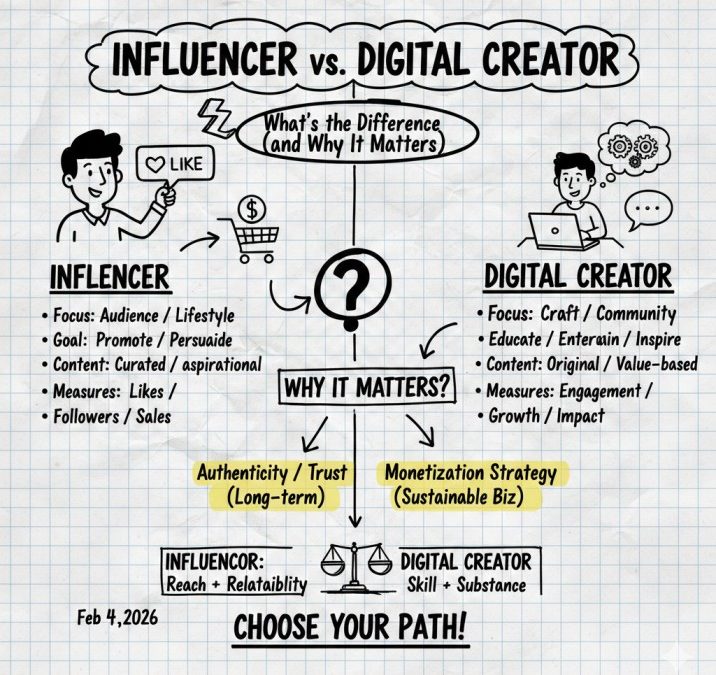
Influencer vs Digital Creator: What’s the Difference (and Why It Matters)
Most brands use these words interchangeably.
That’s expensive.
Because influencers and digital creators are not the same thing, and hiring the wrong one for the wrong job is why campaigns underperform. Let’s clean this up — clearly, practically, and with zero buzzwords.
The One-Line Difference
Influencer = distribution-first
Digital creator = content-first
That’s it. Everything else flows from this.
What Is an Influencer?
An influencer is someone who has attention they can redirect.
Their core asset isn’t content quality.
It’s audience trust + reach.
They influence opinions, preferences, and sometimes behavior — because people follow them, not just their content.
Influencers are great when the goal is:
- brand awareness
- social proof
- trend adoption
- credibility borrowing
They work best when:
- the audience already understands the category
- you want to seed perception
- repetition + familiarity matter
On platforms like Instagram and TikTok, influencers act like human billboards with trust baked in.
Not a bad thing — just a specific role.
What Is a Digital Creator?
A digital creator is someone who produces content that performs, regardless of who they are.
Their core asset isn’t audience size.
It’s content skill.
They know:
- hooks
- pacing
- storytelling
- formats
- editing
- platform mechanics
Many digital creators have small or zero audiences — and still outperform influencers when content is reused as ads, landing page assets, or product demos.
Digital creators are great when the goal is:
- performance marketing
- education & demos
- UGC for ads
- conversion optimization
- scale & consistency
They don’t sell themselves.
They sell clarity.
Side-by-Side: Influencer vs Digital Creator
| Dimension | Influencer | Digital Creator |
| Core strength | Audience & trust | Content quality |
| Primary value | Distribution | Conversion |
| Needs own audience? | Yes | No |
| Best for | Awareness, credibility | Performance, UGC |
| Content style | Personal, opinion-led | Structured, product-led |
| Reusability | Limited | High |
| Cost driver | Reach | Output |
This table alone can save you months of wasted spend.
Where Brands Get It Wrong
Most brands hire influencers when they actually need creators.
Common mismatch:
- Want conversions → hire big influencer
- Want ads → pay for audience reach
- Want scale → rely on personalities
Result:
- expensive posts
- low reuse value
- unclear ROI
That’s not an influencer problem.
That’s a strategy problem.
The Smarter Model (What Winning Brands Do)
High-performing brands separate the two roles.
They use:
- Digital creators to:
- produce high-volume UGC
- test hooks & messages
- fuel ads, landing pages, app stores
- Influencers to:
- seed trust
- legitimize the brand
- amplify proven narratives
Creators find the signal.
Influencers scale the signal.
That combo is deadly (in a good way).
The Future: These Roles Are Diverging, Not Merging
Here’s the key shift most people haven’t clocked:
As platforms mature:
- content skill becomes more valuable than reach
- distribution becomes more fragmented
- trust becomes more contextual
So creators will look more like:
- performance partners
- creative operators
- growth assets
And influencers will look more like:
- brand collaborators
- community leaders
- long-term partners
Different jobs. Different KPIs. Different pricing.
Final Take
If you remember nothing else, remember this:
Influencers move attention.
Digital creators move outcomes.
Great strategies don’t pick one.
They assign the right role to the right problem.
Do that, and suddenly influencer marketing starts making sense again.