
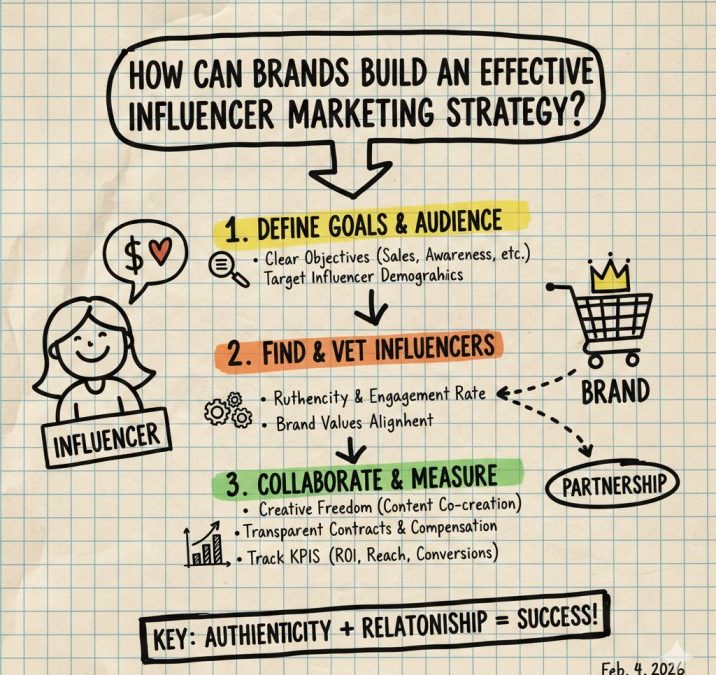
How Can Brands Build an Effective Influencer Marketing Strategy?
Most brands don’t fail at influencer marketing because creators don’t work.
They fail because they don’t have a strategy — just activity.
Random creators.
Random posts.
Random results.
An effective influencer marketing strategy isn’t about finding the perfect creator.
It’s about building a system that compounds.
Here’s how brands that actually see ROI do it.
Step 1: Start With the Wrong Question (On Purpose)
Most brands ask:
“Which influencer should we work with?”
The better question is:
“What behavior do we want to change?”
Do you want users to:
- understand a new product?
- trust a new category?
- switch from a competitor?
- buy again?
Creators don’t create demand.
They translate intent.
If you don’t know the behavior shift you’re aiming for, no creator will save you.
Step 2: Pick the Right Creator Type (Not the Biggest One)
Follower count is a lazy filter.
Effective strategies segment creators by role, not reach:
- Educators → explain complex products
- Demonstrators → show usage & workflows
- Reviewers → build credibility
- Community voices → drive relatability
Nano and micro creators usually outperform here because:
- their audiences are tighter
- trust is higher
- content feels native
Platforms like Instagram and TikTok reward relevance, not fame.
Your strategy should too.
Step 3: Design for Volume, Not Virality
One viral post is luck.
Ten good posts are a strategy.
Effective brands:
- onboard 20–50 creators at once
- test multiple hooks and angles
- run 2–3 content formats in parallel
- expect most content to be average
This is normal.
Influencer marketing works when it looks less like branding
and more like product experimentation.
Velocity beats perfection. Every time.
Step 4: Give Creators Structure (Not “Creative Freedom”)
“Do your thing” is not a brief.
It’s abdication.
High-performing brands provide:
- a clear problem statement
- 3–4 hook directions
- key objections to address
- a strong CTA
Then they let creators execute within that frame.
Creators want constraints.
Constraints create clarity.
Clarity creates performance.
Step 5: Build a Creator Bench, Not Campaigns
Campaigns end.
Creator relationships compound.
Instead of rotating creators every month:
- keep the top 20%
- work with them repeatedly
- improve briefs together
- build familiarity with the audience
Repeated exposure builds trust.
Trust builds conversions.
This is how influencer marketing starts behaving like owned distribution, not rented attention.
Step 6: Distribution Is the Strategy Multiplier
Posting on a creator’s feed is step one — not the finish line.
Winning brands:
- reuse creator content in paid ads
- plug it into landing pages
- test it across email and app stores
- turn it into evergreen assets
Creators create.
Brands scale.
If you’re not redistributing creator content,
you’re leaving 80% of the value on the table.
Step 7: Measure What Actually Moves Revenue
Likes are feedback.
They are not outcomes.
Effective strategies track:
- watch time & retention
- saves and shares
- profile visits
- assisted conversions
- cost per engaged view
Influencer marketing rarely wins on last-click attribution.
It wins by increasing conversion probability across the funnel.
If your metrics don’t reflect that, your strategy is incomplete.
What an Effective Influencer Strategy Really Is
At its core, influencer marketing is:
- a content engine
- a trust layer
- a learning loop
Not a gamble.
Not a brand flex.
Not a vanity play.
Brands that win don’t ask,
“Did this influencer work?”
They ask,
“What did we learn, and how do we scale the signal?”
Final Take
An effective influencer marketing strategy isn’t built in a deck.
It’s built in iterations.
Start small.
Test fast.
Double down on what converts.
Treat creators like a growth engine — not billboards.
That’s how brands stop trying influencer marketing
and start winning with it.