
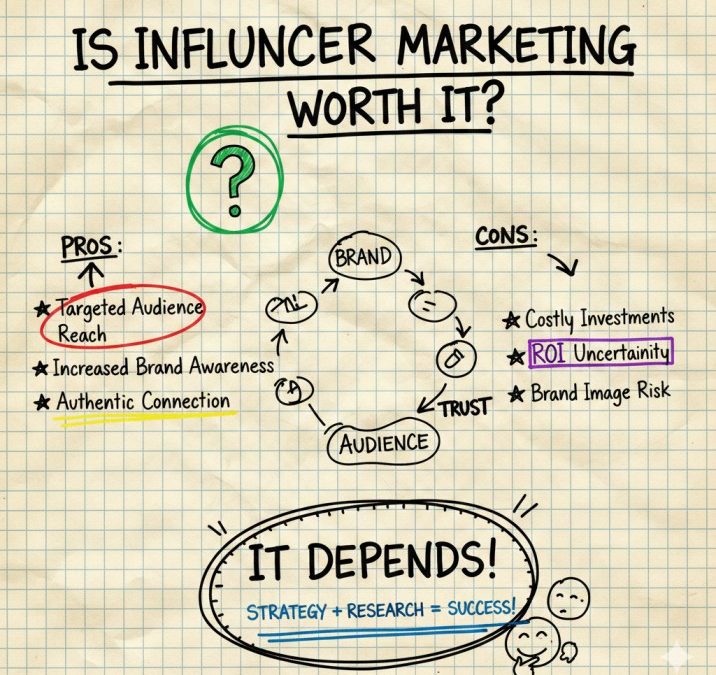
A founder’s take — minus the bullshit.
Short answer: Yes.
Long answer: Only if you stop doing it like it’s 2018.
Most founders asking this question aren’t anti–influencer marketing.
They’re just tired of:
- paying for “reach” that doesn’t convert
- vanity metrics with zero business impact
- creators posting once and disappearing
- dashboards that look busy but explain nothing
So the real question isn’t “Does influencer marketing work?”
It’s:
Is the way we’re running influencer marketing fundamentally broken?
Let’s unpack that.
The Pain: Why Influencer Marketing Feels Like a Scam
Here’s the uncomfortable truth.
Most brands run influencer marketing like a branding expense,
then judge it like a performance channel.
That mismatch kills trust.
What usually happens:
- Brand picks creators based on follower count
- Brief is vague (“make it feel authentic”)
- One post goes live
- Engagement looks… fine
- Sales attribution is unclear
- Everyone shrugs and says “top of funnel”
Rinse. Repeat. Budget cut.
The problem isn’t creators.
The problem is how brands define success.
The Reframe: Influencer Marketing Isn’t a Channel.
Here’s what most founders miss:
Influencer marketing isn’t ads.
It’s distributed trust.
People don’t buy because a creator posted.
They buy because:
- they saw the product used
- explained in plain language
- by someone who feels familiar
- across multiple touchpoints
That’s not a campaign.
That’s the influence compounding over time.
And this is where things get interesting.
What Actually Works in 2026 (From the Trenches)
After running creator programs across D2C, SaaS, fintech, and travel, one pattern is clear:
Creators work best when treated like a content engine, not media inventory.
Here’s the playbook that actually delivers ROI.
1. Stop Buying Posts. Start Building a Creator Bench.
One-off posts are expensive opinions.
Long-term creators are repeatable assets.
Smart brands now:
- onboard 20–50 nano/micro creators
- test content formats, not personalities
- double down on the top 20% performers
- reuse winning content everywhere
The goal isn’t virality.
It’s volume + consistency.
2. UGC > Influencers (Yes, There’s a Difference)
Creators don’t need fame.
They need clarity.
UGC creators:
- follow tight briefs
- deliver fast
- optimize for hooks, retention, and clarity
- don’t dilute messaging with personal branding
This is why brands are shifting budgets from glossy influencers to UGC-led pipelines.
Same spend.
10× more usable content.
3. Distribution Is the Real Multiplier
Creator content dies when it lives on one profile.
Winning teams:
- run creator videos as paid ads
- use them on landing pages
- plug them into email flows
- turn them into app store assets
Creators create.
Brands distribute.
That’s where ROI shows up.
4. Measure the Right Things (Not Likes)
Likes are vibes.
Revenue needs signals.
Track:
- hook retention (first 3 seconds)
- saves & shares
- click intent (profile taps, link clicks)
- assisted conversions
Influencer marketing rarely wins on last-click.
It wins on conversion lift.
If you’re not measuring lift, you’re flying blind.
So… Is Influencer Marketing Worth It?
Here’s the founder-grade answer.
Influencer marketing is worth it if:
- you treat creators as partners, not placements
- you optimize for learning loops, not one-offs
- you design for distribution, not hope
- you value trust as a growth lever
It’s not worth it if:
- you chase follower counts
- you expect instant ROAS
- you outsource thinking to an agency deck
The Bigger Shift Most Brands Haven’t Clocked
Performance marketing is getting noisier.
CPMs are rising.
Attention is fragmenting.
Creators sit in the middle of discovery, trust, and commerce.
That’s not a trend.
That’s a structural shift.
Platforms like Instagram and TikTok didn’t win because of ads.
They won because people trust people.
Brands that get this early build leverage.
Brands that don’t keep asking, “Why isn’t this working?”
Final Take
Influencer marketing isn’t broken.
Lazy influencer marketing is.
If you’re building for the next 3–5 years,
this isn’t optional anymore.
Run a creator sprint next month.
Treat it like product experimentation.
Let the data tell you who to scale.
That’s where the edge is.