
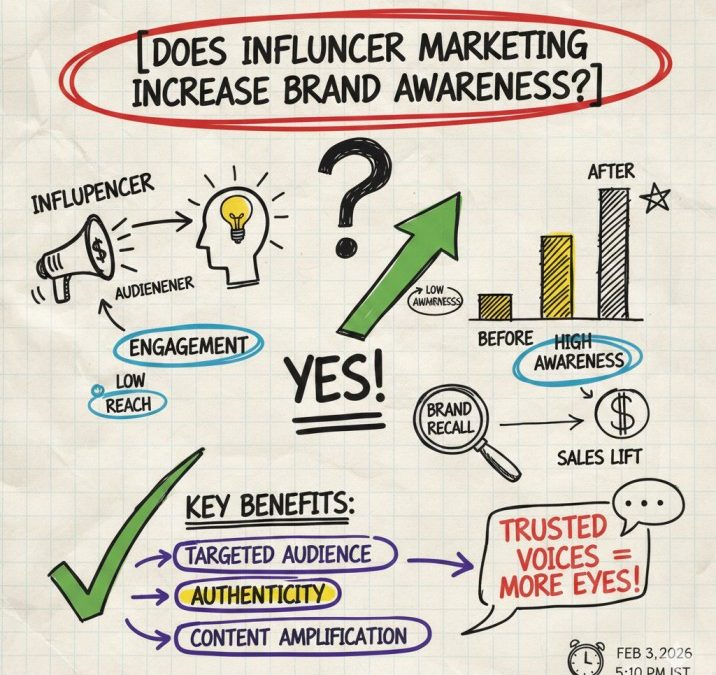
Does Influencer Marketing Increase Brand Awareness?
A straight answer founders don’t usually get.
Short answer: Yes.
Real answer: Only if you understand what “brand awareness” actually means in 2026.
Because if by brand awareness you mean
“a spike in impressions and likes,”
then congrats — that’s the lowest-value outcome influencer marketing can deliver.
The real value is deeper.
And most brands completely miss it.
The Problem: Brands Measure Awareness Like It’s Still a TV Ad
Traditionally, brand awareness meant:
- reach
- impressions
- recall surveys
- “Have you heard of us?”
That model worked when attention was centralized. It breaks in a world where:
- feeds are infinite
- attention is fragmented
- consumers trust people, not logos
Today, awareness isn’t about seeing a brand. It’s about recognizing it when it matters.
The Reframe: Awareness Isn’t Reach. It’s Familiarity.
Here’s the shift most brands haven’t internalized:
Modern brand awareness = repeated, contextual exposure from trusted voices.
Influencer marketing works for awareness not because it’s loud —
but because it’s embedded.
When a creator:
- uses a product naturally
- explains it in their own words
- references it multiple times over weeks
The audience doesn’t feel advertised to. They feel introduced. That’s awareness that sticks.
Why Influencer Marketing Is Structurally Good at Awareness
This isn’t opinion.
It’s how platforms and people behave.
1. Creators Command Attention Where Brands Can’t
On platforms like Instagram and TikTok,
users scroll for people, not companies.
Brand ads interrupt.
Creator content blends in.
That alone makes creators better awareness vehicles than most paid brand creatives.
2. Awareness Compounds Through Repetition, Not Virality
One viral post gives you attention.
Ten smaller creator posts give you memory.
Effective influencer-led awareness comes from:
- multiple creators
- similar messaging
- different formats
- spread over time
This creates a “wait, I’ve seen this before” effect.
That moment is brand awareness doing its job.
3. Creators Contextualize the Brand
Brand awareness fails when people don’t know:
- who the product is for
- when to use it
- why it exists
Creators solve this by default.
They don’t say, “This is a great brand.”
They say, “Here’s how I use this.”
That context is what turns exposure into recognition.
When Influencer Marketing Does Not Build Awareness
Let’s be honest.
Influencer marketing fails at awareness when:
- creators are picked purely on follower count
- posts are one-offs
- messaging is inconsistent
- creators don’t actually fit the category
- content is overly scripted
In those cases, yes — awareness looks inflated and disappears fast.
That’s not an influencer problem.
That’s a strategy problem.
What “Good” Influencer-Led Awareness Looks Like
You won’t always see it in dashboards immediately.
You’ll feel it when:
- prospects say “I’ve been seeing you everywhere”
- sales calls start warmer
- branded search increases
- conversion rates improve without changing ads
- creators mention you without being prompted
That’s awareness doing downstream work.
And that’s where real ROI shows up.
Awareness Is the First Layer of the Funnel — Not the Last
Founders often dismiss awareness because it doesn’t convert instantly.
That’s a mistake.
Influencer marketing increases brand awareness by:
- warming up audiences before ads hit
- reducing skepticism
- shortening consideration cycles
Performance channels convert better when awareness exists.
Influencers don’t replace performance marketing.
They make it work harder.
The Take Most Brands Miss
Influencer marketing doesn’t just increase awareness of your brand.
It increases:
- awareness of the problem you solve
- awareness of when to choose you
- awareness of how you fit into real life
That’s the kind of awareness that actually compounds.
Final Take
Yes, influencer marketing increases brand awareness. But not the shallow, logo-level kind.
It builds:
- familiarity
- recognition
- trust-by-proxy
Brands that treat awareness as a vanity metric stay disappointed.
Brands that treat it as mental availability win long-term.
If people recognize you before they need you —
you’ve already won half the battle.