
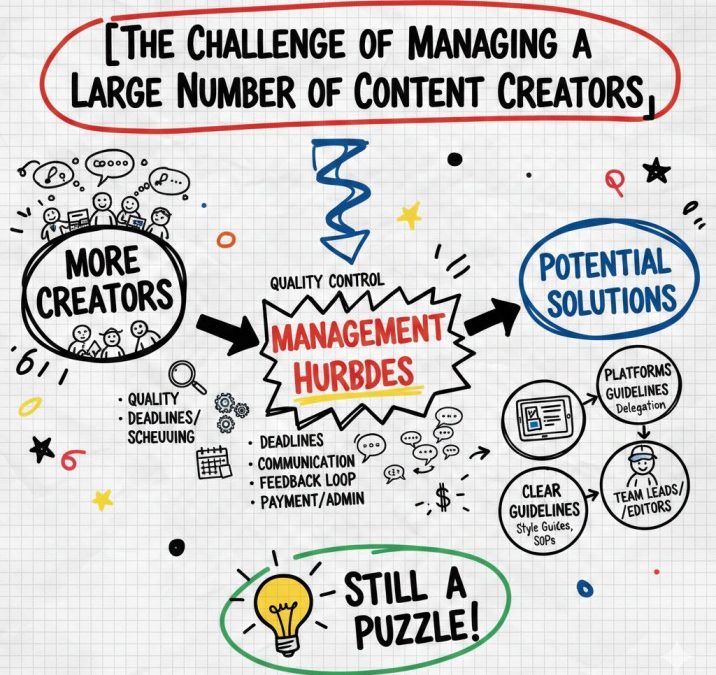
The Challenge of Managing a Large Number of Content Creators
Every brand wants scale.
Every creator program eventually hits chaos.
Managing a handful of creators feels exciting.
Managing dozens feels messy.
Managing hundreds, without a system, quietly breaks teams.
The problem isn’t creators.
It’s operational drag.
And this is where most creator-led strategies stall.
Why Creator Programs Break at Scale
On paper, more creators should mean more content, more reach, more impact.
In reality, teams run into:
- inconsistent content quality
- missed deadlines
- unclear briefs
- scattered communication
- reporting that doesn’t roll up cleanly
Suddenly, what started as a growth lever turns into a coordination nightmare.
Not because creators are unreliable —
but because brands underestimate the cost of orchestration.
The First Friction: Discovery and Onboarding
At small scale, discovery is manual and intuitive.
At large scale, it becomes fragile.
Teams struggle with:
- evaluating creators consistently
- understanding audience relevance
- predicting content quality
- onboarding at speed
Without standard criteria, creator selection becomes subjective.
That leads to uneven results and internal disagreement.
Scale demands repeatable selection logic, not gut feel.
The Second Friction: Briefing at Volume
Briefing one creator is easy.
Briefing fifty is where cracks appear.
Common issues:
- creators interpret briefs differently
- messaging drifts across content
- brand voice becomes inconsistent
- key product points get missed
The mistake brands make is overcorrecting with long documents.
More pages don’t create clarity.
Clear constraints do.
At scale, briefs must be:
- modular
- example-led
- performance-oriented
Otherwise, execution quality decays fast.
The Third Friction: Content Review Bottlenecks
As creator volume grows, review cycles explode.
Teams get stuck:
- chasing drafts
- leaving scattered feedback
- approving content late
- rushing posts live
This slows velocity and frustrates creators.
The hidden cost isn’t just time.
It’s lost learning.
When feedback isn’t structured, brands can’t see patterns:
- which hooks work
- which formats fail
- which creators improve over time
Everything feels noisy instead of directional.
The Fourth Friction: Communication Overload
Most large creator programs run on:
- email threads
- spreadsheets
- DMs
- shared folders
That’s fine at 5 creators.
It collapses at 50.
Creators miss updates.
Teams duplicate work.
Context gets lost.
What breaks here isn’t communication —
it’s single source of truth.
Without one place to track status, timelines, and expectations, scale becomes fragile.
The Fifth Friction: Measurement Without Meaning
This is the most dangerous failure point.
At scale, brands often report:
- likes
- views
- impressions
But can’t answer:
- which creators actually influenced decisions
- which content reduced CAC
- which formats improved conversion
When reporting stays shallow, budgets get questioned.
And when budgets get questioned, creator programs are the first to be cut.
Scale demands signal aggregation, not vanity metrics.
Why This Hits Harder on Creator-Heavy Platforms
On platforms like Instagram and TikTok, velocity matters.
Creators move fast.
Formats evolve weekly.
Audience behavior shifts quickly.
If internal systems can’t keep up, brands lose the advantage creators bring in the first place.
What Managing Creators at Scale Actually Requires
Successful teams don’t “manage creators harder.”
They simplify.
They focus on:
- fewer content formats
- clearer success metrics
- repeat collaborations with top performers
- feedback loops that improve output over time
They treat creator programs like a learning engine, not a one-off campaign machine.
The Real Cost of Getting This Wrong
Poor creator management doesn’t just waste budget.
It:
- burns internal teams
- frustrates creators
- slows experimentation
- weakens trust on both sides
Worst of all, it makes leadership conclude:
“Creators don’t work for us.”
When the truth is simpler:
the system didn’t scale.
Final Take
Managing a large number of content creators isn’t a creative challenge.
It’s an execution challenge.
Brands that solve it unlock:
- faster content velocity
- cleaner insights
- stronger creator relationships
- more predictable outcomes
Brands that don’t stay stuck at small wins.
Scale doesn’t reward effort.
It rewards structure, clarity, and learning speed.
If you want, next we can break this into:
- a creator ops model
- a tooling stack
- or a 90-day plan to scale creator programs cleanly