
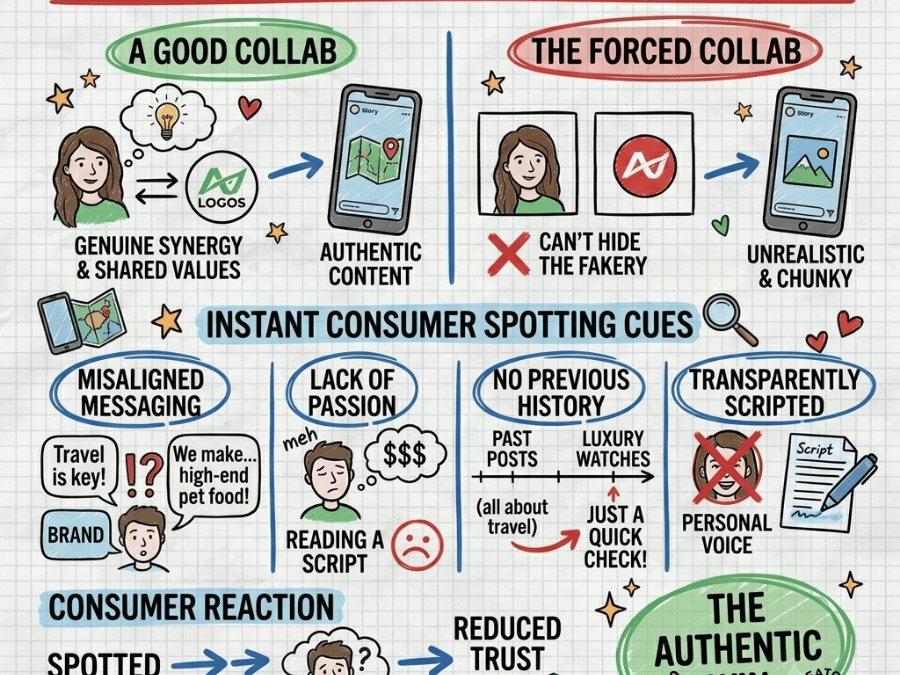
A creator you follow suddenly posts about a new headphone. Or a fintech app. Or a protein supplement that has nothing to do with anything they have ever talked about. You scroll past without reading a word. Maybe you even lose a little respect for them.
That is a forced collaboration and it is one of the most expensive mistakes a brand can make in influencer marketing.
The irony is that forced collabs are usually the result of a brand trying to play it safe. They went with the creator who had the biggest numbers. They gave them a rigid script. They chose reach over relevance. And the audience tuned out completely.
Audiences Are Smarter Than You Think
The average Instagram or YouTube user in 2026 has seen thousands of sponsored posts. They have developed a finely tuned filter for inauthenticity that no amount of production quality can bypass.
They notice when a creator’s energy shifts from their usual tone. They notice when a product appears with no context or backstory. They notice when the caption reads like it was written by a brand manager instead of the person they follow. And when they notice, they do not engage. They scroll.
The trust that a creator holds with their audience is not transferable by transaction. It is loaned to a brand when the fit is right, the content is honest, and the creator actually believes in what they are saying. Force any one of those three conditions, and the loan collapses.
How Forced Collabs Happen
Most forced collaborations are not the result of bad intentions. They are the result of bad processes.
- The brand picks the creator based on follower count, not audience fit: so a travel creator ends up talking about a banking app
- The brief is a script, not a direction: so the creator sounds like a human product brochure
- The brand insists on approving every word: so the creator’s actual voice is edited out of their own content
- There is no relationship between creator and product: so the creator is performing enthusiasm instead of expressing it
Any one of these is enough to produce content that audiences reject. All four together is a guarantee.
The Real Damage Is Not Just Low Engagement
Brands tend to measure the failure of a forced collab through low views or poor engagement rates. But the real damage is harder to track and far more serious.
When a creator posts content that feels inauthentic, it does not just fail to promote the brand, it actively creates a negative association. The audience’s reaction is not neutral. It ranges from apathy to mild contempt. Some of them will remember your brand as the one that made their favourite creator do something weird.
And for the creator, the cost is even higher. Every forced collab chips away at the audience trust they have spent years building. The best creators know this. It is why the best creators are increasingly selective about what they promote and why brands that show up with rigid scripts and misaligned products get rejected by them.
What Authentic Collaboration Actually Looks Like
Authentic collaborations start with a genuine question: does this creator actually use or care about products in this category?
The targeting logic comes second. The fit comes first. A creator who genuinely uses a skincare product will talk about it differently than one who received it two days before the shoot. That difference is visible, audible, and felt and audiences respond to it accordingly.
Give creators a direction, not a script
Tell them what the campaign is trying to achieve. Share the brand’s story. Give them the key message. Then let them translate it into their language, their format, and their world. The post will be better. Always.
Choose relevance over reach
A micro creator with 40,000 followers in the right niche will outperform a mega creator with 2 million followers in the wrong one every single time.
Build a relationship before the brief
Send the product before the contract. Have a conversation. Let the creator develop an actual opinion. If they love it, the content will show it. If they do not, you have learned something important before spending a rupee on production.
The Bottom Line
The brands that win in influencer marketing are not the ones with the biggest budgets or the most famous faces. They are the ones that took the time to find the right creators, trusted them enough to give them creative freedom, and built campaigns that looked like they belonged in the creator’s world, because they did.