
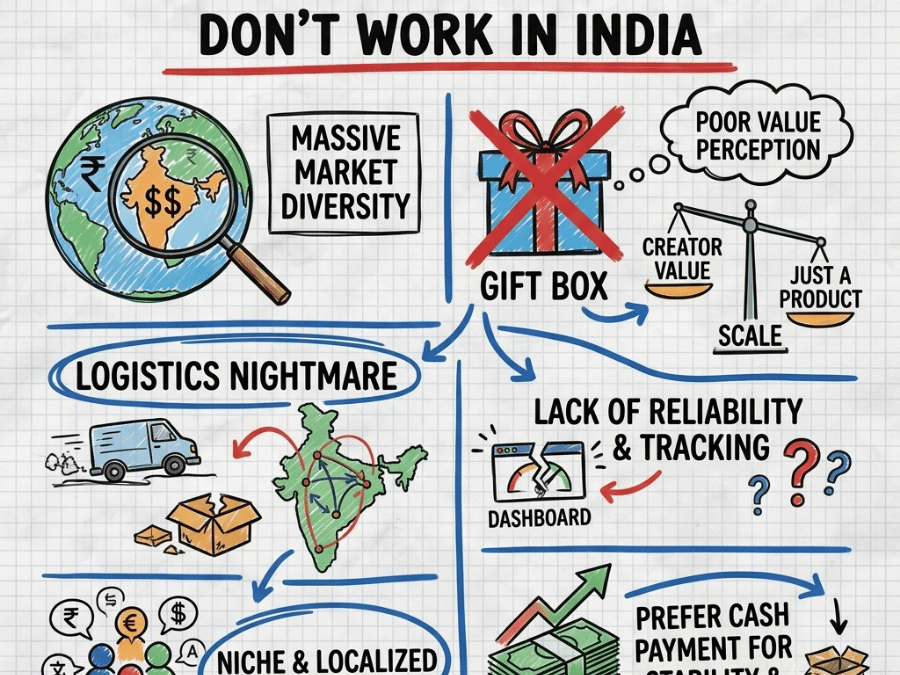
Let’s say it simply: sending a free product to a creator and expecting a viral post in return is not a strategy. It’s wishful thinking.
Barter campaigns – where a brand offers free products in exchange for content have become the default starting point for hundreds of Indian brands entering influencer marketing. And almost all of them end up disappointed. Either the content never comes, or if it does come and it looks like it was made in five minutes, because it was.
The question is: why do barter campaigns fail so consistently in India, and why do brands keep running them?
The Economics Don’t Add Up
Here is the reality that brands refuse to acknowledge: a creator with 100,000 followers has built that audience over years. They have invested time, equipment, editing hours, and creative energy into every single post. When a brand approaches them with a free product worth Rs. 1000 or less and asks for a reel, a story set, and a review, what exactly is the exchange?
The creator gets a product they may not have asked for. The brand gets content that will reach hundreds of thousands of people. By an reasonable accounting, this is not a fair trade.
In markets like the US or UK, barter works to some extent because gifting culture is more established and product value is often higher relative to creator fees. In India, where creator fees are already lower than global benchmarks, asking creators to work for free is an even sharper ask.
What You Actually Get With Barter
When a creator accepts a barter deal, they are doing you a favour and they know it. This dynamic poisons the content before it is even made.
- The creator has no contractual obligation to post, so they may delay indefinitely or not post at all
- Even when they do post, there is no brief, no accountability, and no revision process, so the output reflects zero effort
- The content is almost never on-brand because the creator had no real incentive to understand your brand
- There is no performance expectation, so there is no performance
What brands end up with is content that looks exactly like what it is: a favour. And audiences can smell that from miles away.
Why Indian Creators Specifically Push Back
The influencer ecosystem in India has matured dramatically in the last four years. Creators who once accepted barter because they had no other option now have agencies, managers, rate cards, and a clear understanding of their market value.
Approaching a mid-tier creator with a barter offer in 2025 does not just get you a bad deal, it signals that your brand does not take influencer marketing seriously. You are starting the relationship with a message that says your product is your payment. That is not a partnership. That is exploitation with extra steps.
The Hidden Cost Brands Ignore
Barter campaigns feel free. They are not. Consider what actually goes into running one:
- Logistics: shipping products, managing returns, tracking deliveries
- Time: identifying creators, negotiating, following up endlessly
- Opportunity cost: the weeks spent on barter outreach could have funded one well-executed paid campaign
- Brand equity: every low-quality barter post that goes live is associated with your brand forever
Add it all up, and barter campaigns are not cheap. They are just cheap in the wrong ways.
What Works Instead
Pay creators fairly, even if that means working with fewer of them. One creator who is genuinely invested in your brand or your product, has creative freedom, and is being compensated properly will always outperform ten creators who received a free product.
If budget is genuinely a constraint, be honest about it. Approach creators whose niche aligns tightly with your product. Offer exclusivity, long-term partnerships, or affiliate structures that give them upside. There are ways to make limited budgets work but none of them involve pretending the product is the payment.
Barter had its moment. That moment has passed. Brands that still lean on it are not saving money. They are spending it badly.